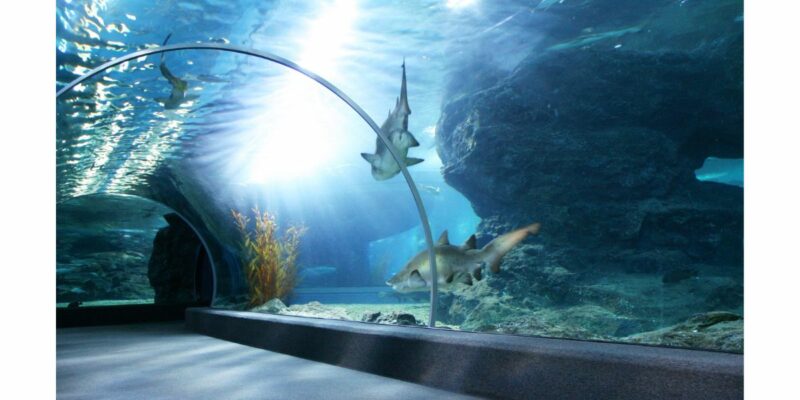
The presentation highlights that numerous large acrylic aquariums have failed in public and residential settings, leading to significant losses. Engineering analysis can determine the “how” and “why” of these failures, and the concepts discussed are applicable to other acrylic applications.
Aquariums range in size from 10-gallon hobby tanks to immense 13-million-gallon public installations. Public aquariums between 500 and 100,000 gallons are common in malls, restaurants, and lobbies, with an increasing number of million-plus gallon aquariums being built in zoos and aqua centers. An acrylic aquarium must perform in diverse environments and endure sunlight, thermal changes, fresh and salt water, and exposure to various chemicals and stresses like food materials, alcohol, chlorine, and impact.
Large aquariums are made of plastic, specifically poly(methyl methacrylate) (PMMA), also known as acrylic or Plexiglas, rather than glass.
Benefits of using plastic include:
- Design and shape flexibility
- Shatter/impact resistance—ideal for an acrylic aquarium, as it’s less brittle than glass
- Exceptional clarity
- Ability to join large sections for huge tanks
- Half the weight of glass
- Good chemical resistance
Potential issues with acrylic include:
- Scratch resistance
- Requirement for very accurate assembly without added stress
- Plastic creep/rupture over time
- Lower chemical resistance compared to glass
- Extreme notch sensitivity
Acrylic is also used in large windows, lighting, art, translucent roofing, underwater high-pressure windows, hyperbaric chambers, tubing, cylinders, and sheets. Large and thick acrylic panels are commonly made by casting, including continuous casting, which results in stress-free, high-clarity panels with high molecular weight and mechanical properties ideal for an acrylic aquarium design. Panels are often heated and formed, then placed in an oven to release stresses before assembly.
Each step in acrylic aquarium manufacturing is critical to prevent failure. Large panels are cast into exact shapes. Surfaces to be bonded must be smooth and particle-free. A syrup and/or solvent adhesive is carefully applied to both the spacer and panel sides, and panels are fitted exactly without force. The molecular bonding process, which results in a joint retaining 70-90% of the panel strength, requires the panels to be held firmly in place.
Causes of acrylic aquarium failure can stem from:
- Manufacturing: Requirement for very good acrylic, exact shape/size, no flaws in panels, and minimal molded-in stress to prevent plastic creep.
- Assembly: Critical for a tight fit without added stress; panels should not be forced together. The adhesive process, including proper adhesive selection and application, is crucial. Poor bonding is a significant cause of failure.
- Installation: Loads must be distributed evenly, and the tank must be installed level and without twisting. The tank stand must be solid and resistant to movement. Joints are designed for watertightness and shock absorption. Correct sealant (e.g., Dow Corning 795) and proper application are essential.
- Damage: Deep nicks or gouges in an acrylic aquarium can lead to failure.
- Maintenance: Tanks should be kept clear of external loads, though designs should account for some unexpected impacts. Acrylic has issues with certain chemicals (alcohol, acids, aggressive solvents, strong chlorinated cleaners), and exposure can lead to failure months or years later, even with thicker panels and proper installation.
Acrylic’s strength decreases over time. While most aquariums are over-designed with significant panel thickness and a safety factor of 11-14x, the creep rupture strength significantly declines over time. For example, the design stress for a 10-year life is 1500 psi, while for a 20-year life, it’s 650 psi—critical for planning a sustainable acrylic aquarium.
Acrylic is highly notch-sensitive. Sharp notches can lead to crack propagation and catastrophic failure. A sharp scratch of just 0.01 inch (0.25 mm) can decrease the tensile strength by 50%. An acrylic aquarium’s panel thickness and safety factors typically account for expected pedestrian scratches.
Various testing methods aid in determining the “how” and “why” of acrylic aquarium failures. Understanding which tests to perform and the information they provide is crucial. Knowledge of plastic behavior is critical to understanding the root cause of failure. Tools include:
- Microscopy: Allows examination of fine crack features, helps locate crack initiation points, determines if a crack progressed slowly or from a high-energy event, and provides information on acrylic condition.
- FTIR (Fourier Transform Infrared Spectroscopy): Identifies organic and some inorganic compounds, including plastic type, additives/fillers, foreign substances deleterious to acrylic, and sealants used in acrylic aquarium assembly.
- Material Property Analysis: Uses methods like tensile testing (ASTM D 638) to provide information on modulus, strength, strain at yield, and elongation at break. Dynamic Mechanical Analysis (DMA) can determine modulus drop with temperature increases. Lifetime prediction can be achieved through structural analysis, tensile testing, and DMA.